
Your Cart is Empty


Every katana is really two things: the blade, and the mounting that lets a human hand use it. The Japanese call that mounting the koshirae, and for centuries it has been where swordsmiths, lacquer artists and metalworkers put their personal stamp on a sword. When you design a custom sword, the koshirae is where most of your choices live. Here is what each part does, and what to think about when you choose it.

A katana in full mounting: handle, guard and lacquered scabbard inlaid with insects. Blade 17th century, mounting 19th century. The Metropolitan Museum of Art, public domain.
The habaki is the metal collar that sits at the base of the blade, just in front of the guard. It looks decorative, but it does two important things. It wedges the sword snugly into the mouth of the scabbard, so the blade is held by the collar rather than resting on its edge, and it locks the guard and spacers tight against the handle. Habaki are traditionally made of copper, brass or silver, and a well-fitted one gives that satisfying, firm click when the sword is sheathed.
The tsuba sits between blade and handle. It stops the hand from sliding onto the edge, and because it adds weight close to the hands it also affects how the sword balances and moves. Thin brass spacers called seppa sit on either side of it to keep everything tight.
Early guards were plain and practical, often simple iron plates. Over time they became one of the great miniature art forms of Japan. Makers cut away the metal in sukashi (openwork) patterns that lighten the guard while keeping it strong, and carved, engraved and inlaid scenes of flowers, animals and landscapes.

A round iron tsuba with openwork (sukashi) cut-outs, 16th century. The Metropolitan Museum of Art, public domain.
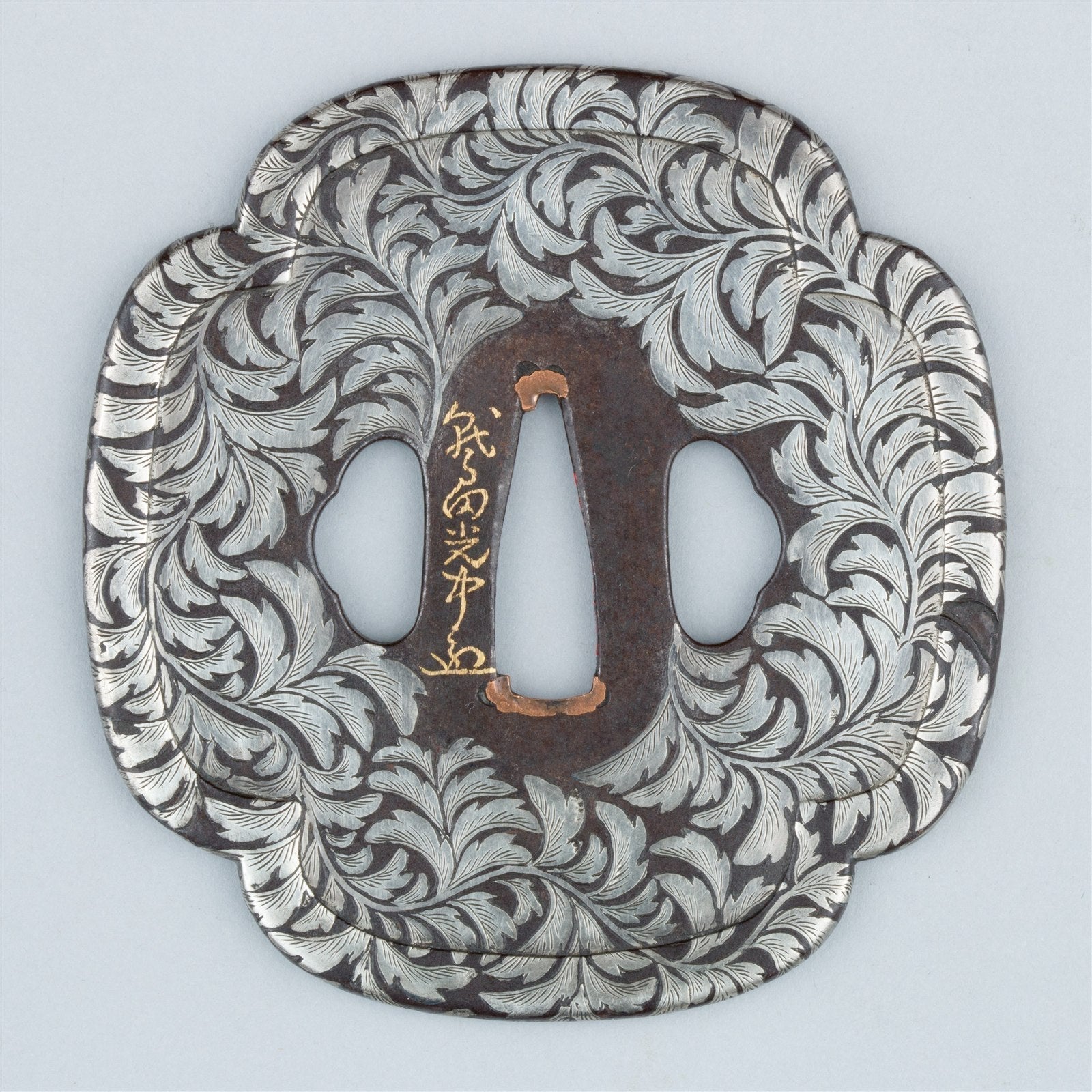
Shape matters as much as decoration. A round guard ( maru) is the classic choice. The four-lobed mokko shape, like the engraved guard below, has a softer, more ornamental outline. Size matters too: a larger guard gives more protection and moves the balance slightly back toward the hands.

A four-lobed (mokko) tsuba engraved with scrolling foliage, 19th century. The Metropolitan Museum of Art, public domain.
The handle, or tsuka, is a wooden core fitted precisely to the blade's tang. It is held on by a bamboo peg ( mekugi) that passes through the handle and the tang, which is why a well-made handle should never rattle. The core is covered in samegawa, ray skin, whose pebbled surface stops the wrap from slipping. Over that goes the tsuka-ito, a flat cord of silk, cotton or leather wound in the familiar crossing pattern that leaves diamond-shaped windows of ray skin showing.
Silk is the traditional luxury choice and looks superb. Cotton is durable and grippy, which is why many practitioners prefer it for regular training. Leather is tough and takes hard use well. Whatever the material, a tight, even wrap is what makes a handle feel solid in the hand.

A handle and guard up close: the wrap, the menuki under it, and the scabbard cord (sageo). Blade 16th century, mounting 19th century. The Metropolitan Museum of Art, public domain.
Look closely at a handle and you will find small metal ornaments tucked under the wrap on each side. These are menuki. They fill the palm and help the grip, and they are also one of the most personal decorative choices on the sword: dragons, cranes, flowers and family crests are all common.
At each end of the handle is a metal fitting. The fuchi is the collar next to the guard, and the kashira is the cap at the butt of the handle. They protect the ends of the wooden core and anchor the wrap, and they are usually made as a matching pair. Choosing fuchi, kashira, menuki and tsuba around a single theme is the easiest way to give a sword a coherent character.
The scabbard, or saya, is traditionally carved from two halves of soft, stable wood and then lacquered. Lacquer is where scabbards become art: glossy black, deep red and brown, textured finishes, and inlays of mother-of-pearl like the one on the sword at the top of this page. A small knob on the side, the kurigata, carries the sageo, a flat cord used to tie the sword to the belt or to secure it for display.
A good saya fits the blade closely enough that the sword stays put when held upside down, yet releases smoothly when drawn. For a training sword, a sturdy finish matters more than a delicate one. For a display piece, the lacquer is your chance to make a statement.
A useful way to design a mounting is to decide on function first and decoration second. Start with how the sword will be used: training, cutting practice or display. That points you to a sensible handle wrap, guard size and scabbard finish. Then choose a theme, whether that is a dragon, a crane, pine trees, maple leaves or simply clean black and silver, and let it guide the tsuba, menuki and fittings so every part tells the same story.
You can try these combinations yourself in our custom sword builder, where you can choose every part described here: habaki, tsuba, menuki, handle fittings, ray skin, handle wrap, scabbard, scabbard fittings and even a scabbard inlay, and see finished examples in our custom sword gallery. If you are unsure what suits your style of practice, get in touch and we will be happy to help.