
Your Cart is Empty


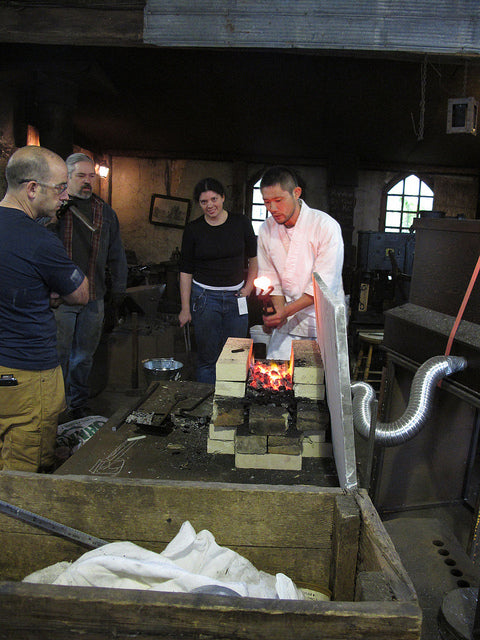

A defining characteristic of traditional Japanese swords is the use of differential heat treatment. During the region's feudal period, swordsmiths discovered that coating the spine with clay before quenching the entire blade with water or oil resulted in several unique characteristics. Known as differential heat treatment, it allowed the spine to cool more slowly than the edge. Differential heart treatment has since become synonymous with Japanese swordsmithing, largely because of the following benefits that it offers.
#1) Removed Voids in Metal
Differential heat treatment helped swordsmiths remove voids in metals. When voids form, it lowers the strength and overall quality of the sword. Prior to the advent of differential heat treatment, voids were a problem. However, this practice has since allowed Japanese swordsmiths to create high-quality swords that are free of voids.
#2) Removed Impurities
Of course, differential heat treatment also works to remove impurities from the metal. All metals contain impurities in the form of other metals, minerals and elements. Even at small concentrations, though, the presence of these impurities can negatively affect a sword's strength and quality. If a particular area of the sword has accumulated impurities, it will likely be weaker than the rest of the sword. And sudden impact or force on that area may cause the sword to break. However, Japanese swordsmiths discovered that differential heat treatment removed impurities from metals, allowing them to create better swords.
#3) Strong Edge and Flexible Spine
The greatest benefit of differential heat treatment is its ability to create a sword with a strong edge and flexible spine. Strength isn't the only important characteristic of a sword. If a sword was strong but not flexible, it had a high chance of breaking upon impact. This is why Japanese swordsmiths used differential heat treatment to create swords with a strong spine.
#4) Evenly Distributed Carbon
A fourth benefit of differential heat treatment is its ability to evenly distribute carbon throughout the blade. Adding carbon to steel allowed for the creation of stronger swords. However, it was important for swordsmiths to evenly distribute this carbon so that one area of the sword wasn't stronger the rest.
#5) Create Many Layers
Finally, differential heat treatment allows for the creation of many layers by decarburizing the outside of the blade and essentially forcing it into the blade's interior. Some sources say that traditional Japanese swords like the katana had up to 65,000 layers. This doesn't necessarily mean that the swordsmith created each of these layers by hand. Rather, the layers are created naturally through differential heat treatment.

What the habaki, tsuba, tsuka, menuki, fuchi, kashira and saya actually do, and how to choose each one when you design a custom katana. Illustrated with museum pieces from the Metropolitan Museum of Art.