Your Cart is Empty
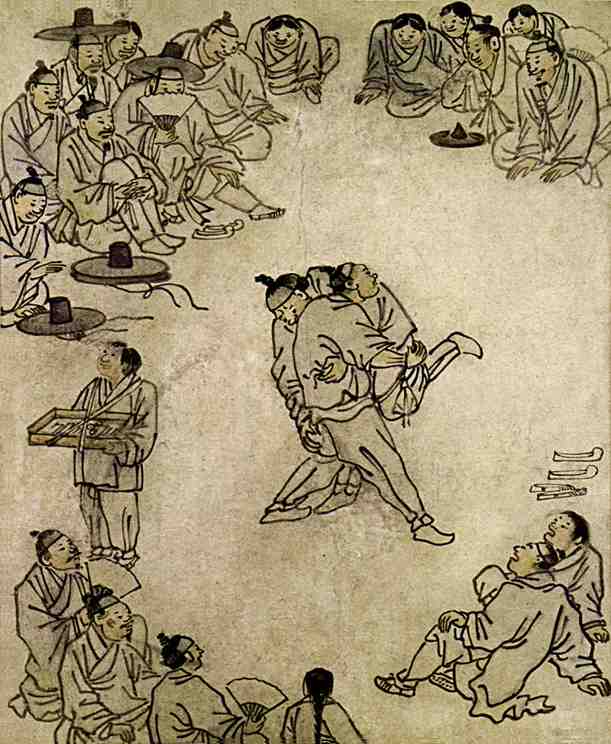

Korea isn't a region where you'd probably expect wrestling to be popular. However, the region has a long history of this sport that dates back all the way to the 4th century. Although there are several types of traditional Korean wrestling, the most popular is ssireum. A form of traditional Korean folk wresting, it's become a national sport in the region. To learn more about Korean ssireum, check out the following five facts about this sport.
#1) It Was First Televised in the 1900s
Although ssireum has been around for centuries, it didn't gain mainstream popularity until the 1900s when it was televised throughout South Korean. According to Wikipedia, the first modern ssireum competition occurred in 1912 at the Dansongsa theater in South Korea. Fast forward to the 1960s, and ssiereum was televised throughout South Korea, bringing the sport to countless people who had otherwise not seen or heard about it.
#2) Competitions Are Held in a 7-Meter Ring
Like sumo wresting, ssireum competitions are held in a small ring. Practitioners must stay within the 7-meter ring at all times while simultaneously trying to bring down their opponent. During a typical ssireum competition, there are three judges who specifically watch the two practitioners to see who steps -- or is forced -- out of the ring. Unlike sumo, however, knocking an opponent out of the ring doesn't result in an automatic win. Rather, it simply restarts the match. To win a competition, a practitioner must bring their opponent to the ground so that any part of their body above the knee touches the ground within the 7-meter ring.
#3) There Are 4 Weight Classes
There are four specific weight classes in ssireum: Taebeak (80 kg), Geumgang (90 kg), Halla (105 kg) and Baekdu (under 160 kg). Practitioners were weighed to determine which weight class they'll practice in. The four aforementioned weight classes of sseireum are named after the four well-known mountain peaks on the Korean Peninsula.
#4) The First World Ssireum Championship Was Held in 2015
Ssireum has been around for quite some time, though it wasn't until 2015 when the first World Ssireum Championship was held. It took place at the Thuwana Indoor Stadium in Myanmar on Sept. 18, with the host country, Myanmar, walking away with the win. The second World Ssireum Championship, however, was won by Germany, with the third and fourth being won by South Korea.
#5) Hits and Slaps Aren't Allowed
A key difference between ssireum and sumo wrestling is that only the latter allows physical hits and slaps. In sumo wresting, it's perfectly fine for practitioners to hit each other. In ssireum, however, this is strictly prohibited. Rather, ssireum practitioners must take down their opponent using grappling techniques. This makes it a safer all-around sport, as there's a lower risk of bodily injury.

What the habaki, tsuba, tsuka, menuki, fuchi, kashira and saya actually do, and how to choose each one when you design a custom katana. Illustrated with museum pieces from the Metropolitan Museum of Art.