Your Cart is Empty
 Few regions have influenced the centuries-old craft of swordmaking as much as Japan and Korea. Whether you practice swordsmanship in martial arts, or if you're a collector who appreciates fine-quality blades, you'll see similar elements from both of these regions.
How Japan Influenced Korean Swordmaking
Some people assume that modern-day Korean swords are just "reproductions" of Japanese swords, but this couldn't be further from the truth. With China to the northwest and Japan to the southeast, Korea's culture has been shaped over time with the help of its neighbors.
Among the first swords to originate out of Korea was the Hwandudaedo. This double-edged ring-pommel sword was originally limited to members of the royal family due to its rarity. It wasn't until the turn of the 3rd century when the Hwandudaedo made its way into the middle class and military. Some historians speculate that the Hwandudaedo was influenced by straight swords of Japan, such as the tsurugi, and single-edged swords of China, such as the Jian.
Fast forward to the Joseon period (15-19th century), and Korea began using single-edged sword, much like its neighbors in China and Japan. Of course, this shouldn't come as a surprise given the numerous military incursions into Korea by these countries. In 1627, for instance, China's Manchu Qing Empire invaded Korea, defeating the Joseon dynasty. And Japan invaded the region in 1592 and 1597. These military incursions almost certainly resulted in the blending of cultures and crafts, including swordmaking.
Modern-Day Korean Jingum vs Japanese Katana
Today, both the Korean jingum and Japanese katana share striking similarities in terms of design, material of construction (steel is preferred), and craftsmanship. Furthermore, they are both prized in swordsmanship competitions due to their superior level of quality.
In terms of differences, however, the Korean jingum is typically crafted with a thinner and wider blade than its katana counterpart. As such, many practitioners say the jingum feels lighter than a katana. This doesn't apply to all Korean Jingums, however. Some are heavier with thicker blades than katanas; it all depends on the swordsmith and how he or she crafted it.
To recap, both Korean and Japanese swords share many common characteristics, including the use of a single-edge, a curved blade, and a similar sized hilt. The only real difference is subtle nuances in how the blades are made, with Korean jingums typically featuring a thinner and wider blade.
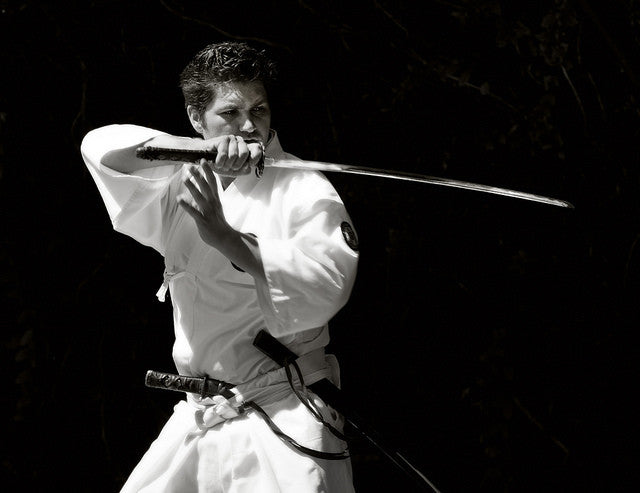
Photo credit: Robert Couse-Baker
Visit our Korean sword collection to see examples.


What the habaki, tsuba, tsuka, menuki, fuchi, kashira and saya actually do, and how to choose each one when you design a custom katana. Illustrated with museum pieces from the Metropolitan Museum of Art.