
Your Cart is Empty


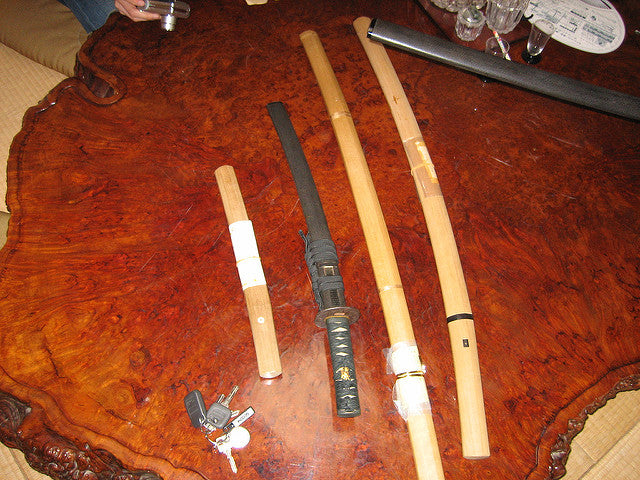

From the katana and wakizashi to the tanto and tachi, nearly all traditional Japanese swords were produced with a guard. Separating the bottom of the sword's blade from the top of its hilt, this component played an important role in both the function and aesthetics of the sword. The guard was such as an essential element in traditional Japanese swords that a new school emerged designed specifically for this craft.
Overview of Shoami
Shoami is a traditional Japanese art of crafting sword guards. It's designed to teach individuals how to craft high-quality guards for traditional Japanese swords. According to Wikipedia, Shoami originated sometime during Japan's Muromachi period (1333 to 1573). Back then, samurai warriors began using the uchigatana. With its relatively long blade, samurai warriors needed a guard to protect them from self-injury, thus paving the way for Shoami.
Originally, Shoami was performed strictly for functional purposes, with samurai warriors requiring guards on their swords to protect against self-injury. This prompted craftsmen to produce guards using strong metals like iron and high-carbon steel. During Japan's Edo period (1603 to 1868), however, regional peace reduced the need for functional guards and, subsequently, shifted the focus of Shoami to aesthetic purposes.
Producing a sword guard may sound like a simple enough task, but it's actually a time-consuming and laborious process that requires a high level of skill and determination. In feudal Japan, these components were made by craftsmen whose sole purpose was to create tsubas.
Although there were exceptions, most traditional Japanese sword guards featured a circular shape. This is in stark contrast to European swords, which featured a horizontal guard known as a crossguard. Because it wrapped completely around the sword, circular sword guards offered a higher level of protection from self-injury than crossguards.
How Shoami Affected Japanese Swordsmithing
Shoami influenced many aspects of Japanese swordsmithing. It encouraged swordsmiths to use symmetrical elements in their design to create a cohesive style. Higo sword guards, for example, are believed to have influenced the style of swords produced by famous swordsmiths like Hayashi Matashichi and Miyamoto Musashi.
To recap, shoami is the art of crafting sword guards for Japanese swords. Although it was initially done for functional purposes, the art was later performed for aesthetic purposes. Today, much of Shoami has faded, with only a small number of people practicing it. If it weren't for this craft, however, perhaps traditional Japanese swords like the katana would look entirely different.
Photo credit: Jeremy Hall

What the habaki, tsuba, tsuka, menuki, fuchi, kashira and saya actually do, and how to choose each one when you design a custom katana. Illustrated with museum pieces from the Metropolitan Museum of Art.