
Your Cart is Empty


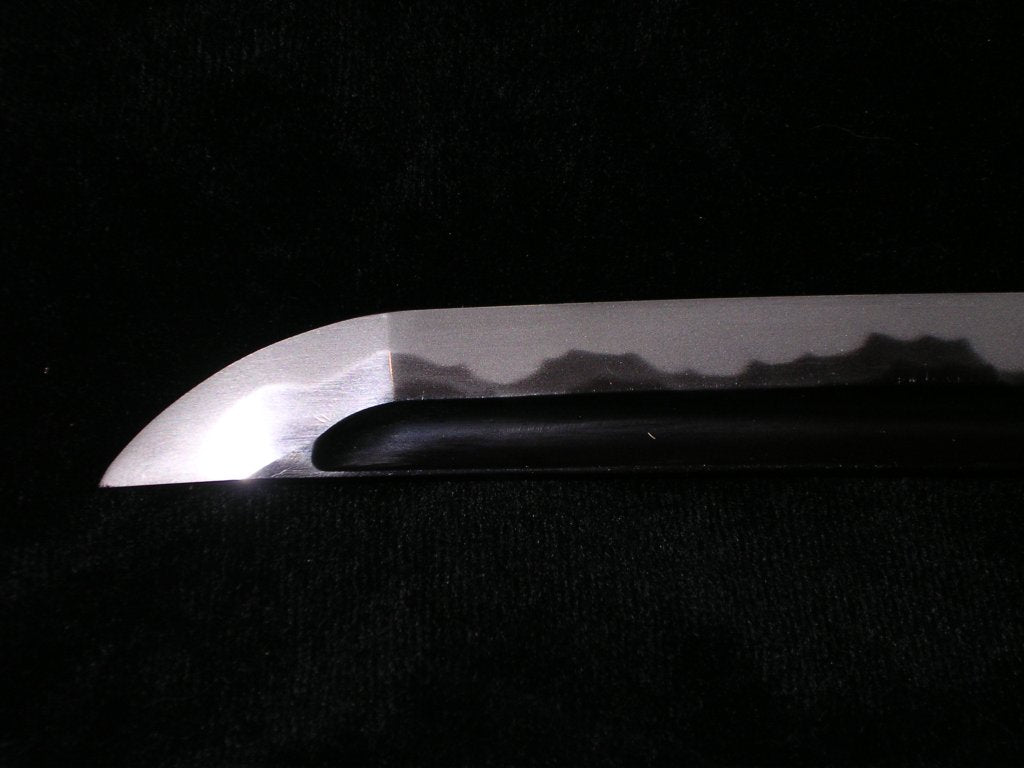

When looking at examples of traditional Japanese swords, you may discover a unique pattern along the spine or edge of the blade. Known as hamon, it's become synonymous with Japanese swords like the katana and wakizashi. So, what is a hamon exactly, and why was is it used in Japanese swords?
Overview of the Hamon
As shown in the photo above, the hamon is a unique design that runs part or all the length of a Japanese sword's blade. While some people assume that swordsmiths created hamons for aesthetic purposes, this isn't necessarily true. Granted, there's certainly a stylish element associated with hamons, but they were actually the byproduct of another swordsmithing technique: differential hardening.
How Differential Hardening Creates Hamons
In feudal Japan, swordsmiths discovered that heating and cooling a sword's edge and spine at different rates resulted in different properties. For example, a swordsmith would apply clay to the spine of a blade so that it cooled more slowly than the spine. Known as differential heat treatment, this allowed the edge to harden more quickly, whereas the spine converts to martensite.
The hamon is essentially formed where the transition of the martensite to the blade's primary metal occurs. A traditional Japanese katana may feature a tamahagane blade. However, the hamon outline defines the presence and location of the martensite, which is created through differential heat treatment.
Purpose of the Hamon
Swordsmiths rarely went out of their way to create a hamon. Rather, it was the byproduct of differential heat treatment. Traditional Japanese swordsmiths knew the importance of using differential heat treatment in the production of their swords. It helped them to create swords that had a strong edge yet flexible spine, thus making them invaluable for samurai warriors. To create these characteristics in a sword, however, swordsmiths were forced to use differential heat treatment. And the end result of this process was the formation of hamons.
History of the Hamon
Like many other aspects of traditional Japanese swordsmithing, the exact origins of the hamon remain shrouded in mystery. However, legend has it that famous swordsmith Amakuni Yasutsuna -- who created the first single-edged sword with a curved blade -- pioneered this practice sometime around the 8th century. The story goes that Yasutsuna saw the emperor's army with badly damaged swords. In response, he and his son, Amakura, gathered the blades and began repairing them. After about a month, the father-son swordsmithing duo emerged with newly forged swords that featured differential hardening along with the characteristic hamon designs.

What the habaki, tsuba, tsuka, menuki, fuchi, kashira and saya actually do, and how to choose each one when you design a custom katana. Illustrated with museum pieces from the Metropolitan Museum of Art.