
Your Cart is Empty


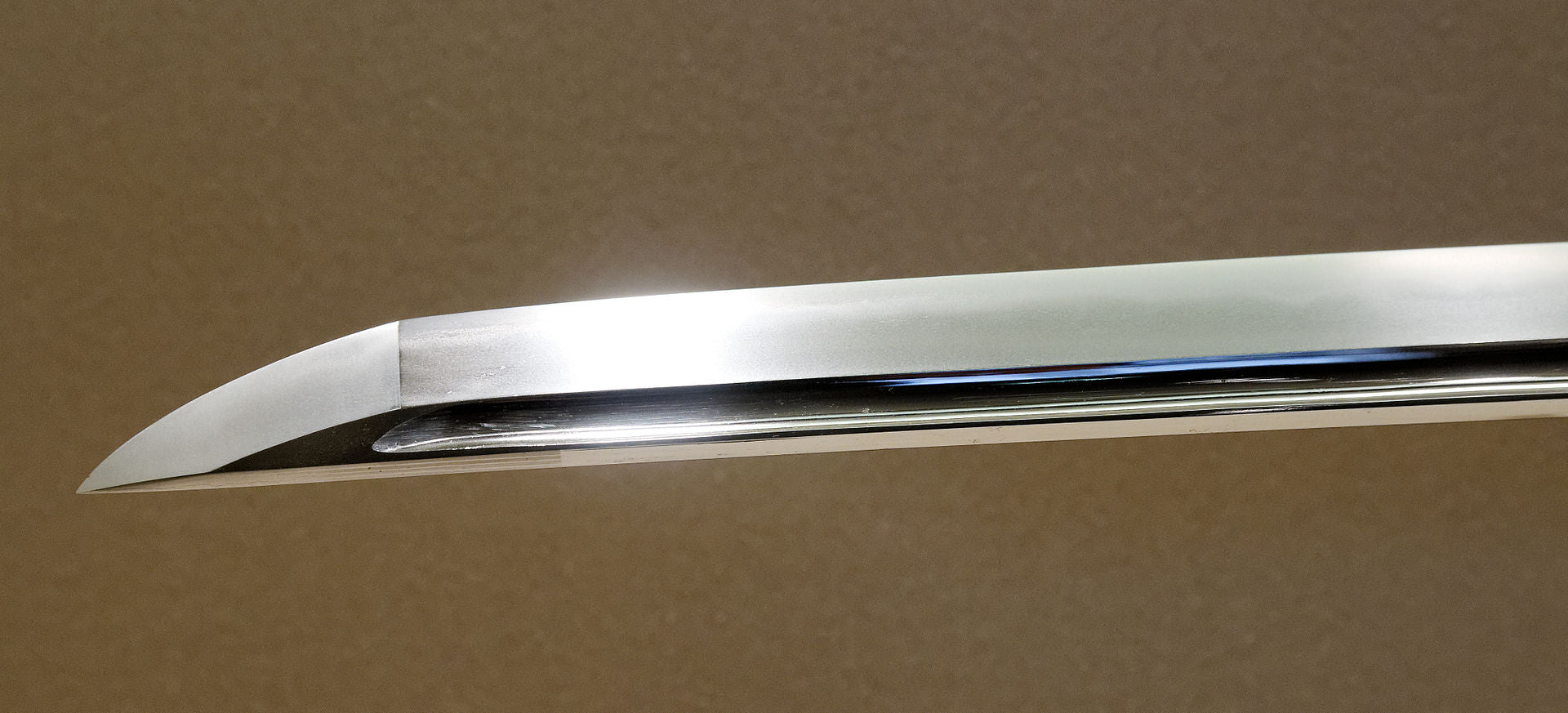

Whether it's a katana, wakizashi, tanto, tachi or kodachi, all traditional Japanese swords feature a kissaki. Unless you're familiar with these swords, though, this might be the first time hearing the word "kissaki." So, what is the kissaki, and what role does it play in creating a high-quality Japanese sword?
Kissaki Explained
The kissaki is essentially the very tip of a traditional Japanese sword. As shown in the image above, it's formed where the blade begins to shrink, eventually creating a sharp point. All traditional Japanese swords have a kissaski, even smaller companion swords worn and used by samurai warriors. Without this otherwise essential element, traditional Japanese swords wouldn't be effective on the battlefield.
Different Types of Kissaki
Of course, there are different types of kissaki, each of which has a unique design. Okissaski, for example, has a medium-length point, whereas kokissaki has a short-length point. The third type of kissaki is ikuri-okisasski, which is characterized by a unique design in which the blade's point hooks backwards.
How It's Made
The kissaki was typically made by grinding down the metal adjacent to the sword's point. This wasn't an easy task, nor was it fast. It often took weeks for swordsmiths to sharpen a sword and create the kissaki.
When creating the kissaski, swordsmiths had to use caution so that they wouldn't grind away too much of the blade's metal. Ideally, just enough metal should be ground away to form a sharp point that retains the blade's overall shape and design. If too much metal is removed, the end result is a lacklustre weapon that's ineffective for fighting.
Importance of the Kissaski
The kissaski plays a key role in the function of traditional Japanese swords. It's designed to improve the versatility and lethality of swords by creating a sharp point that can be used for piercing attacks. Without a well-defined kissaki, samurai warriors wouldn't be able to use the sword for such attacks. They could still use the sword for slashing, but samurai warriors wouldn't be able to use it for piercing. This isn't a problem, however, considering that all traditional Japanese swords were made with a kissaski.
The kissaski is just one of many design elements that goes into creating a traditional Japanese sword. Swordsmithing wasn't just a pastime in feudal Japan; it was a major part of the Japanese culture. Swordsmiths invested their lives into building the world's finest swords, and this attention to detail remains apparent in swords like the katana.

What the habaki, tsuba, tsuka, menuki, fuchi, kashira and saya actually do, and how to choose each one when you design a custom katana. Illustrated with museum pieces from the Metropolitan Museum of Art.